Western carpenter ants ( Camponotus modoc and Camponotus vicinus ) do not consume cellulose for nutrition like subterranean termites; instead, worker ants excavate smooth nesting galleries directly within…
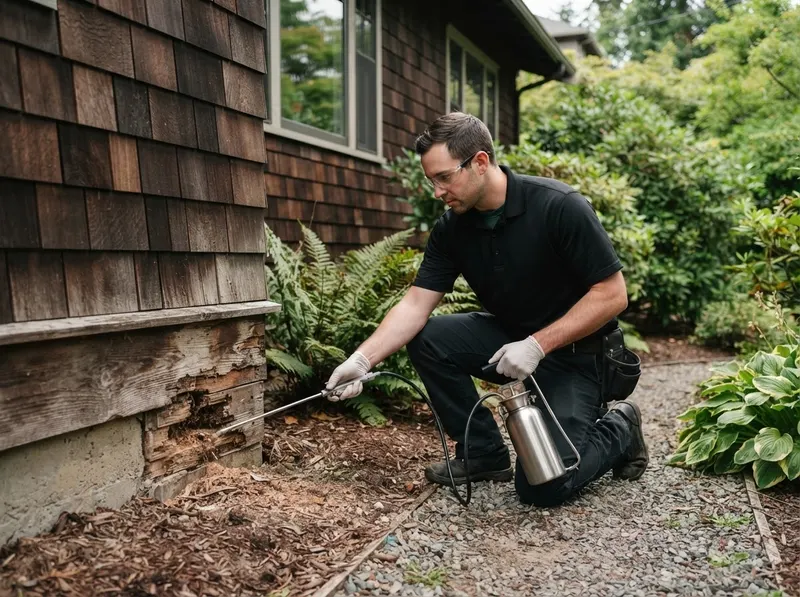
Western carpenter ants (Camponotus modoc and Camponotus vicinus) do not consume cellulose for nutrition like subterranean termites; instead, worker ants excavate smooth nesting galleries directly within moisture-damaged fir and pine timber. In the maritime climate of the Pacific Northwest, regular rainfall exceeding 38 inches annually drives fungal wood decay along roof valleys, window sills, and subfloors. Homes throughout historic neighborhoods like Ballard, Queen Anne, and Capitol Hill frequently feature Douglas fir framing that absorbs ambient humidity, creating prime conditions for satellite colonies. Ironleaf Exterminating applies systematic structural defense rather than generic surface spraying. Field technicians inspect exterior moisture zones using guidelines from the Washington State University Extension to isolate the connection between damp exterior vegetation and interior wall voids. Technicians check crawlspaces near basement footings, perimeter insulation, and plumbing penetrations to locate the smooth frass shavings that signal hidden galleries, cross-referencing findings against structural protection recommendations published by the US EPA Citizen Guide to Pest Control.
Eradicating a carpenter ant colony requires distinguishing between localized satellite nests located indoors and parent colonies rooted outside in old tree stumps, landscape ties, or cordwood. In leafy districts such as Magnolia, Green Lake, and West Seattle, mature hemlock, cedar, and maple canopies often touch gutter lines, creating elevated transit highways into upper attic soffits. Ironleaf Exterminating uses targeted, non-repellent perimeter applications evaluated under the Washington State Department of Agriculture Pesticide Program. Foraging workers cross these treated structural contact points without detection, carrying microscopic doses of the active ingredient back into the core nest where communal food sharing (trophallaxis) neutralizes the queen. For indoor living spaces and homes with sensitive gardens, technicians incorporate naturally derived borate minerals evaluated by the USDA Natural Resources Conservation Service, eliminating the need to evacuate living areas or compromise indoor air quality.
Selecting localized colony elimination versus comprehensive exterior perimeter defense depends on the structural age and landscaping clearance of the building. For newer construction in Fremont or Wallingford with dry building envelopes, a single-colony targeted void injection directly halts interior excavation without broad-spectrum chemical coverage. For older Craftsman properties in Beacon Hill or Columbia City bordering greenbelts like Discovery Park, dense vegetation creates continuous structural reinfestation pressure. In these environments, establishing a physical vegetation clearance zone of 12 to 18 inches away from foundation masonry aligns with safety protocols from the Occupational Safety and Health Administration and pest mitigation standards from the Public Health Seattle King County. Technicians also confirm compliance with municipal housing maintenance directives maintained by the Seattle Department of Construction and Inspections.
Structural protection succeeds when moisture remediation occurs alongside insect eradication. Ironleaf Exterminating provides explicit repair documentation for compromised rim joists, ledger boards, and fascia boards, referencing building rehabilitation principles outlined by the US Department of Housing and Urban Development and timber health criteria from the US Forest Service. By addressing the damp microclimate that attracted the workers initially, property owners prevent future queens from establishing secondary nesting sites. Homeowners can reach our regional desk directly by calling (253) 648-3797 to arrange a detailed site inspection.
Every job gets a firm, written price after a free on-site visit.
For standards, safe disposal, and service guidance on PEST CONTROL SEVICE in Seattle, WA, useful references include U.S. EPA, ENERGY STAR, U.S. Dept. of Energy, Consumer.gov, U.S. Census Bureau, and Google Maps. General consumer and small-business resources are available from USA.gov, Better Business Bureau, FTC Consumer Advice, U.S. Small Business Administration, and Ready.gov.
Tell us about your carpenter ant eradication job in Seattle and we'll send a clear, written quote, usually the same day.
 Ironleaf Exterminating