Seattle's maritime climate delivers an average of 38 inches of annual precipitation, driving chronic crawl space dampness and subterranean fungal rot. These conditions attract wood-destroying organisms that accelerate…
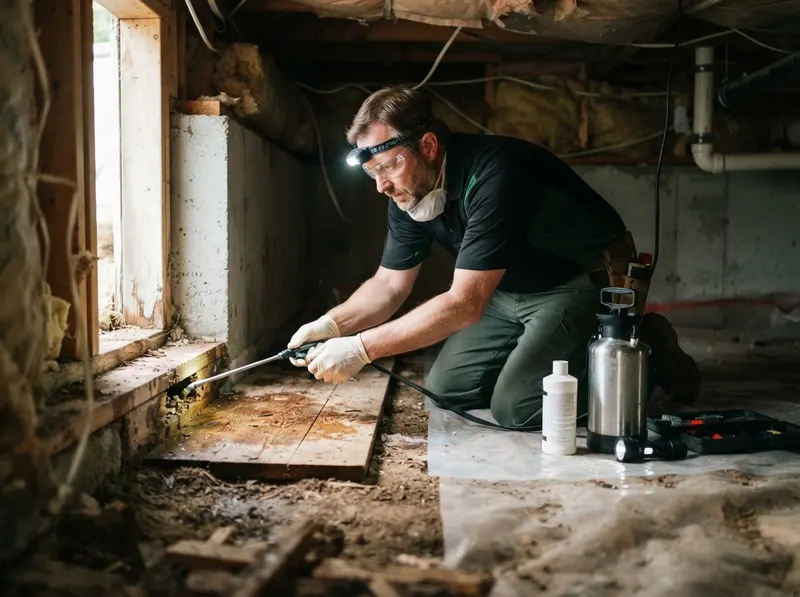
Seattle's maritime climate delivers an average of 38 inches of annual precipitation, driving chronic crawl space dampness and subterranean fungal rot. These conditions attract wood-destroying organisms that accelerate structural decay. Yellow moisture ants nest exclusively inside softened, decaying cellulose, while anobiid wood-boring beetles spend two to five years in an active larval state digesting damp subfloor joists. Standard surface barrier sprays fail against these species because the colonies and wood-boring larvae remain insulated deep inside framing timbers. Structural remediation requires locating hidden pockets of subfloor fungal decay where internal relative humidity exceeds 20 percent. Ironleaf Exterminating utilizes pinpoint pinless moisture detection based on National Institute of Standards and Technology engineering guidelines to isolate active galleries behind lath, plaster, and crawl space posts without causing unnecessary cosmetic damage.
Treatment selection depends on structural moisture readings and the depth of gallery damage across basement sills, wall studs, and roof decking. When moisture ants colonize bathroom floor plates in older Craftsman homes in Queen Anne or Wallingford, remediation focuses on physical access, gallery extraction, and the targeted injection of non-repellent borate formulations. Water-soluble borate mineral salts, evaluated by the U.S. Environmental Protection Agency, diffuse into cellulose fibers, neutralizing timber-chewing insects while preserving indoor air quality and garden beds. When anobiid powderpost beetles attack Douglas fir framing in subterranean basements across Ballard and Magnolia, high-pressure wood micro-injection delivers therapeutic residuals directly into beetle flight holes. Unlike broad-spectrum pyrethroid fogging, this systemic approach halts larval feeding cycles without off-gassing volatile organic compounds into upper living quarters.
Long-term structural defense requires coupling biological eradication with moisture mitigation. Wood-destroying insects cannot sustain colony propagation in wood that remains below 12 percent moisture content. Ironleaf Exterminating integrates structural remediation with crawl space vapor barrier upgrades, working within standards published by the U.S. Department of Energy and moisture abatement specifications outlined by the U.S. Department of Housing and Urban Development. Technicians seal sill-plate gaps using elastomeric sealants, clear foundation weep vents, and coordinate with restoration specialists when timber integrity requires sistering or reinforcement. Homeowners in West Seattle, Fremont, and Columbia City receive verifiable fungal moisture readings and discrete structural reports, avoiding multi-year chemical subscription locks in favor of permanent physical defense.
Remediation protocols also align with regional environmental protections and building requirements. All pest control measures comply with environmental guidelines from the Washington State Department of Agriculture and waste disposal mandates defined by the Washington State Department of Ecology. Ground operations near sensitive urban shorelines, including the Hiram M. Chittenden Locks and Green Lake Park, follow integrated pest management principles established by the Natural Resources Conservation Service and safety benchmarks from the Occupational Safety and Health Administration. Where structural pests interface with historic properties or tree canopies, treatments reference technical guidance from the U.S. Forest Service and consumer protection policies overseen by the U.S. Department of Commerce.
Every job gets a firm, written price after a free on-site visit.
For standards, safe disposal, and service guidance on PEST CONTROL SEVICE in Seattle, WA, useful references include U.S. EPA, ENERGY STAR, U.S. Dept. of Energy, Consumer.gov, U.S. Census Bureau, and Google Maps. General consumer and small-business resources are available from USA.gov, Better Business Bureau, FTC Consumer Advice, U.S. Small Business Administration, and Ready.gov.
Tell us about your moisture ant and wood-boring beetle remediation job in Seattle and we'll send a clear, written quote, usually the same day.
 Ironleaf Exterminating