Pacific dampwood termites (Zootermopsis angusticollis) and western subterranean termites (Reticulitermes hesperus) inhabit distinct ecological niches in Western Washington. According to Washington State University…
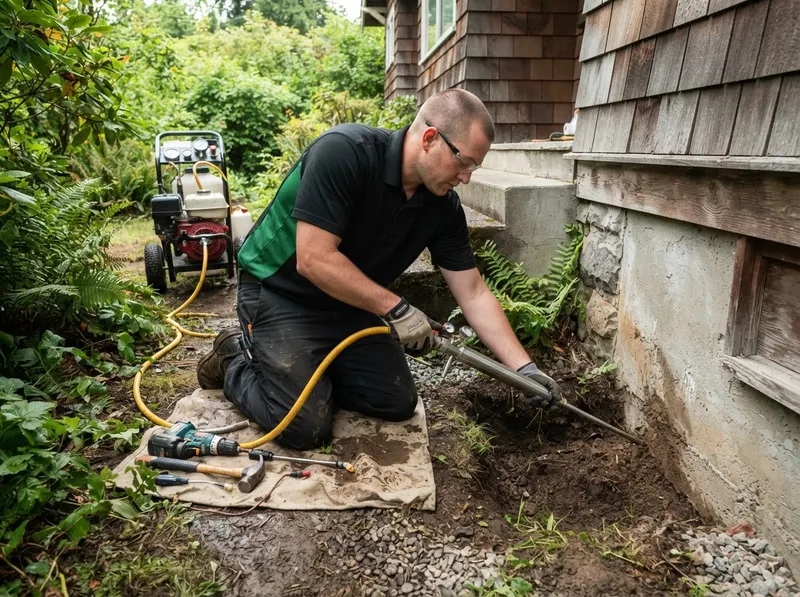
Pacific dampwood termites (Zootermopsis angusticollis) and western subterranean termites (Reticulitermes hesperus) inhabit distinct ecological niches in Western Washington. According to Washington State University Extension forestry publications, dampwood species require continuous timber saturation above 20% moisture content to survive, whereas subterranean colonies maintain ground contact and construct earthen shelter tubes over concrete stem walls. Older architectural framing across Queen Anne, Fremont, and Ballard often features uninsulated post-and-pier foundations where soil grade sits directly against structural wood. Ironleaf Exterminating focuses on halting structural loss by pairing structural moisture rectification with targeted mineral applications rather than saturated broadcast chemistry.
Dampwood termite activity in Seattle commonly mimics wood-decay fungi, thriving inside shaded roof eaves or crawlspaces along the Lake Washington ship canal and near the Hiram M. Chittenden Locks. In contrast, subterranean termites establish satellite networks under concrete foundation slabs in Magnolia and Capitol Hill basements. Standards established by the Pest Control Technology technical guides indicate that non-repellent liquid termiticides, applied strictly into backfilled perimeter trenches, provide continuous exclusion without altering indoor air quality or leaching into backyard vegetable soils. The Environmental Protection Agency mandates exact dosing protocols for subterranean barrier applications to avoid groundwater drift near marine shorelines.
Defense sequencing involves three measurable stages. First, crawlspaces receive continuous relative humidity testing using instruments calibrated to National Institute of Standards and Technology criteria, locating wood with moisture content exceeding the 19% threshold that supports dampwood establishment. Second, foundation wood receives penetrating disodium octaborate tetrahydrate treatments, an inorganic mineral salt detailed by the United States Forest Service for long-term timber preservation that eliminates digestive protozoa in wood-boring insects. Third, subterranean ground access is severed via targeted soil trenching along sub-grade stem walls, consistent with residential safety guidelines documented by the Washington State Department of Agriculture.
Choosing targeted structural defense over whole-home fumigation aligns with urban Seattle lot configurations. Zero-lot-line townhomes in Wallingford, West Seattle, and Columbia City eliminate the physical clearance required for structural tenting, while dampwood colonies rarely occupy dry upper stories. If timber exhibits localized dampness from foundation drainage issues near Green Lake Park or Beacon Hill hillsides, localized borate saturation and mechanical moisture diversion solve the root issue. If subterranean shelter tubes extend past cold-pour joints in basement concrete, low-pressure perimeter soil treatments intercept workers without introducing airborne aerosols into living spaces.
Every job gets a firm, written price after a free on-site visit.
For standards, safe disposal, and service guidance on PEST CONTROL SEVICE in Seattle, WA, useful references include U.S. EPA, ENERGY STAR, U.S. Dept. of Energy, Consumer.gov, U.S. Census Bureau, and Google Maps. General consumer and small-business resources are available from USA.gov, Better Business Bureau, FTC Consumer Advice, U.S. Small Business Administration, and Ready.gov.
Tell us about your subterranean and dampwood termite defense job in Seattle and we'll send a clear, written quote, usually the same day.
 Ironleaf Exterminating